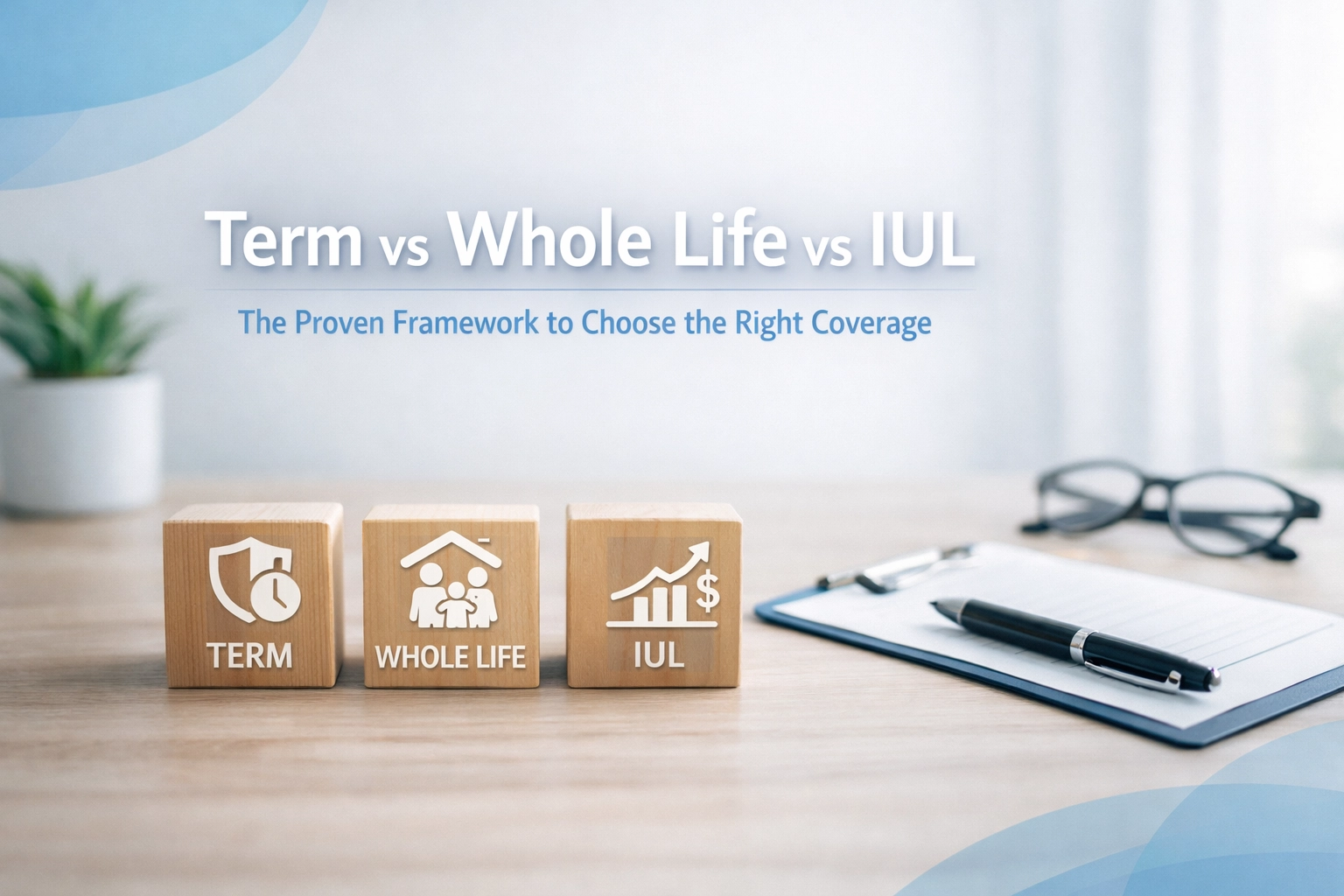
You're sitting at your kitchen table, staring at three life insurance proposals, and they might as well be written in a foreign language. One costs $35 a month, another wants $350, and the third has charts showing something about "market indices" that make your head spin. How do you know which one actually protects your family without emptying your wallet?
Here's the truth: choosing between Term, Whole Life, and Indexed Universal Life (IUL) isn't about which product is "better." It's about which one matches where you are right now and where you're headed. Let me break this down in a way that actually makes sense.
The Three Types of Life Insurance: What You're Really Buying
Term Life Insurance is like renting coverage. You pay a fixed premium for 10, 20, or 30 years, and if something happens to you during that time, your family gets a death benefit. If you outlive the term? The policy ends, and you walk away with nothing. No cash value, no refunds: but also premiums that can be under $30 per month for substantial coverage.
Whole Life Insurance is permanent coverage with training wheels. Your premiums are fixed for life and never increase. Part of what you pay builds cash value at a guaranteed interest rate, and that cash grows tax-deferred. It's straightforward, predictable, and requires zero management beyond paying your bill.
Indexed Universal Life (IUL) is permanent coverage with a turbocharger: and more moving parts. Your cash value is tied to a stock market index (like the S&P 500), which means it has growth potential beyond fixed rates. You also get flexibility to adjust premiums and death benefits. But this complexity means you need to actively monitor performance and understand how caps, floors, and fees affect your returns.

The Real-World Framework: Matching Coverage to Your Life
Let me tell you about three clients I worked with last month who each needed something completely different.
Maria, 32, married with two young kids. She needed $500,000 in coverage to replace her income if something happened while her children were young. Her budget was tight: daycare alone was killing them. We got her a 20-year term policy for $32 per month. When her kids are grown and financially independent, she won't need that massive death benefit anymore. Term insurance gave her maximum protection during the years that mattered most without breaking the bank.
David, 58, planning retirement. He wanted coverage that would never expire, guaranteed costs, and a way to leave something behind for his grandchildren. He wasn't interested in watching market performance or adjusting policy settings. We set him up with Whole Life: fixed premiums, guaranteed cash value growth, and absolute certainty. He pays his premium monthly, and that's the last he thinks about it. No surprises, no stress.
Jennifer, 45, self-employed business owner. She had irregular income: some months were great, others were lean. She wanted permanent coverage but needed flexibility to adjust premium payments when business was slow. She also had a higher risk tolerance and believed the market would support long-term growth. An IUL policy gave her the flexibility to pay more in good years and less in tough ones, with cash value tied to market index performance (with downside protection when the index drops).
Side-by-Side: What You Need to Know
| Feature | Term Life | Whole Life | IUL |
|---|---|---|---|
| Duration | 10-30 years | Lifetime | Lifetime |
| Premiums | Fixed, then expires | Fixed forever | Flexible |
| Cash Value | None | Guaranteed growth | Market-linked |
| Best For | Budget-conscious, temporary needs | Predictability seekers | Active managers with growth goals |
| Monthly Cost | $30-$100 | $250-$500+ | $200-$600+ |
How to Choose: The Questions That Actually Matter
Choose Term Life If:
- You need massive coverage right now but can't afford permanent insurance premiums
- You're protecting specific time-sensitive obligations (mortgage payoff, kids through college)
- You're young and healthy: your premiums will be incredibly low
- You don't need lifetime coverage or care about building cash value
Choose Whole Life If:
- You want zero surprises and absolute guarantees
- You prefer simplicity: pay your premium and forget about it
- You have final expense needs (burial costs, estate planning)
- You value stability over potentially higher returns
- You're uncomfortable with market-linked investments
Choose IUL If:
- You're willing to actively monitor and manage your policy
- You want flexible premiums to accommodate income fluctuations
- You have higher risk tolerance and believe in long-term market growth
- You want growth potential beyond fixed interest rates
- You understand how caps, floors, and fees impact returns
The Critical Mistake People Make
Here's what trips people up: underfunding permanent policies. Both Whole Life and IUL require consistent, adequate funding to maintain coverage. With IUL especially, if your cash value doesn't grow enough to cover policy costs, your coverage can lapse unexpectedly: even after paying premiums for years.
I've seen this happen. A client came to me with an IUL policy he bought 10 years ago. He was paying minimum premiums during years of poor market performance, and his policy was on the verge of collapse. We had to significantly increase his payments to save the coverage. Had he chosen Whole Life with its guaranteed premiums, this never would have happened.
What About Converting or Combining?
Many people don't realize you can convert term policies to permanent coverage before the term ends: without a medical exam. This is huge if your health declines during the term period.
Some families use a hybrid approach: term insurance for massive coverage during high-need years, plus a smaller Whole Life or IUL policy for lifetime needs and cash value accumulation. This gives you maximum protection now without overextending your budget, while still building permanent coverage.

Peace & Grace's Proven Process
For over 10 years, we've helped California families navigate exactly this decision. Our A+ BBB rating reflects our commitment to getting you the right coverage: not just any coverage.
Here's how we work: We look at your complete financial picture: debts, dependents, income, timeline, and risk tolerance. Then we show you real quotes from multiple carriers for each type of coverage. You see the actual costs, not theoretical examples. We explain how each policy works in plain English, and we're here years later when you have questions.
Ready to Get This Right?
Life insurance isn't something you figure out alone at midnight on Google. You need someone who speaks insurance fluently and translates it into decisions that make sense for your family.
Get an instant quote through our partner Ethos Life: Start Your Quote Here
Or schedule a personal consultation where we'll compare all three options with real numbers specific to your situation: Book Your Free Consultation
We're Peace & Grace Insurance Services: your local California insurance agency with over a decade of helping families make confident insurance decisions. Whether you need affordable term coverage for the next 20 years or permanent insurance with cash value growth, we'll show you exactly what you're buying and why it matters.
The right life insurance isn't the most expensive or the one with the fanciest features. It's the coverage you can afford to keep, that matches your timeline, and that lets you sleep at night knowing your family is protected. Let's find yours.